

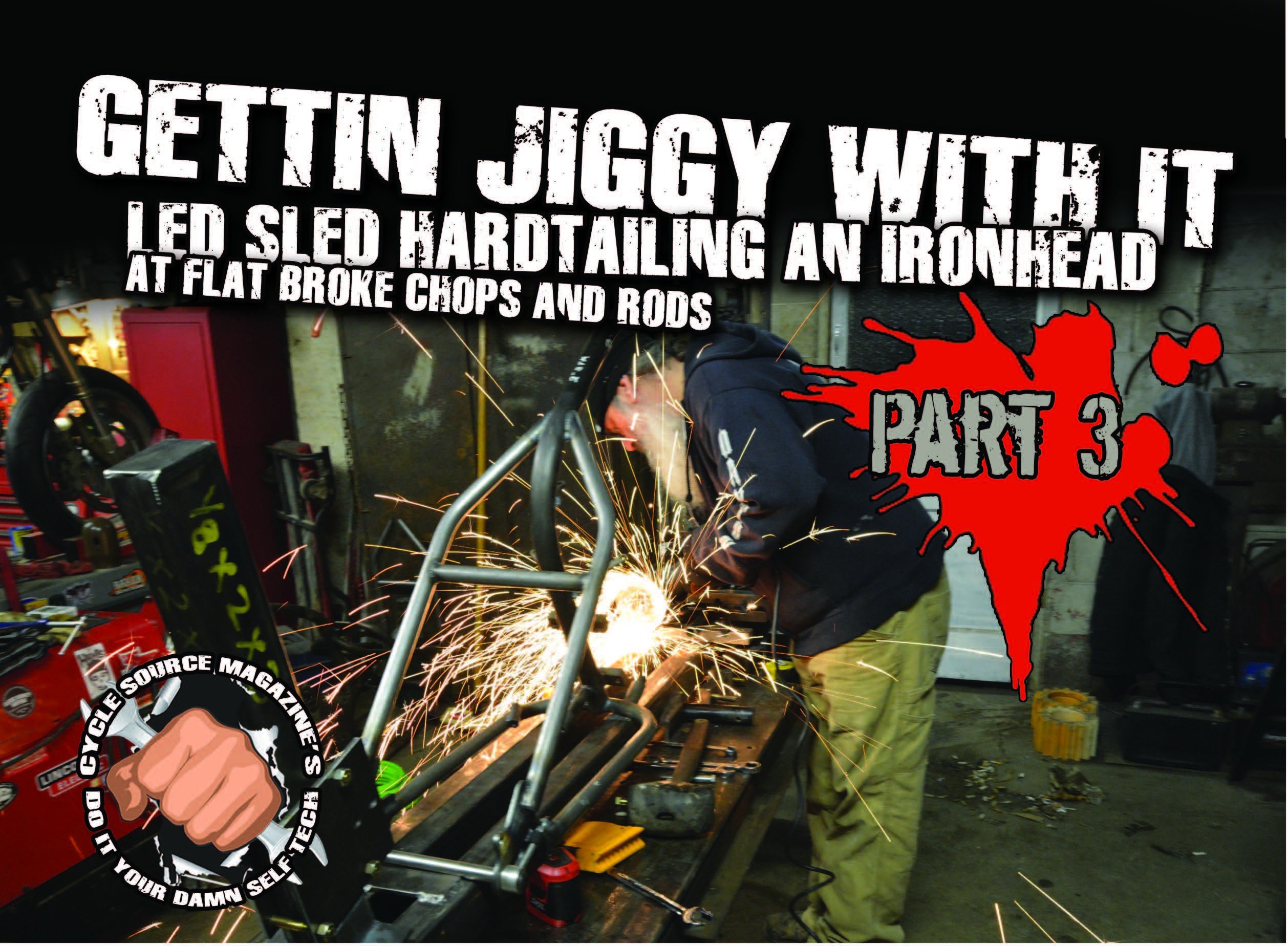

Led Sled Hardtailing An Iron Head At Flat Broke Chops And Rods – Part 3
Article by – Chris Callen – Editor In Chief
Photos by – Heather Callen – Managing Editor
Originally Published In The June 2015 Issue Of Cycle Source Magazine
This month we are putting our homemade frame jig into action at Flat Broke Chops & Rods. Last month, we left off with the fixtures complete for the Ironhead Sportster frame. In this installment we are using the jig to install a Led Sled Customs Weld-On Hardtail Kit. This is a great way to go about hardtailing a sportster, because the Led Sled kit gives the garage builders a nice complete package, with which they can be sure of fitment and quality. With that said, let’s get to work.

So, here is the kit as it comes from Led Sled. For a real decent price you get about everything you’ll need to turn the stock Ironhead into a bitchin little bobber.

After holding the hardtail up to the frame and getting a rough idea of where we will be cutting, we remove the bulk of the stock rear section. The actual cuts will be more precise later.

Not that it needs mentioning, but as we remove the stock parts, it’s easy to see why these things sit so high and look bulky.

Here you can see the slugs on the bottom frame rails of the hardtail kit and how they will slide into the stock frame. The wall thickness is common to our .134 frame tubing, an important factor in insuring strength of the welded area.

With a little more precision this time, we hold the hardtail up to stock frame to begin marking the location of the final cuts. Remember, “measure twice, cut once”

With our stock frame mounted to our rear motor mount fixture on the frame jig, we can get an exact mark to make the final cut on the bottom rails.

Here Mark slowly makes the final cuts with the SawZall to the bottom frame rails.

Since the frame is old and wasn’t kept in the best condition, we use a die grinder to remove the scale and rust from inside the frame tubing. This will make installation smoother, and avoid any potential weld contamination.

With the lower rails cut to the exact length, we can make our final lines on the backbone.

Mark uses the electric grinder to make the final cut on the backbone and creating a nice clean edge.

With the hardtail section fitting well and everything looking square, we begin to prep the job for welding. We start by dimpling the frame rails so holes can be drilled for the initial rosette welds.

We start these holes out with a 1/8th inch bit and then move to the 5/16th final size.

With the rosette holes drilled and the frame and the hardtail section cleaned we are ready for welding.

Before we weld, we take one last look at how everything is lining up. Our laser line shows a good position on the hardtail.

At the same time, our axle fixture shows good spacing from side to side, suggesting we have everything in position.

With our final look satisfied, we begin welding. We start with the rosette welds since this will hold the job in position when we take it out of the jig.

Once those welds are complete, top and bottom, we let it cool off and remove the frame from the jig to complete the welding. We do a little at a time, jumping back and forth, to control heat input in the frame.

Here you can see both the rosette welds and the one on the seam. I know they’re not quite stacked dimes but structurally these are good welds. The final welds are cleaned with a stainless steel brush and visually inspected for any voids or imperfections.

In summation, the Led Sled kit performed as we expected. It’s a great price at $1,096 for a ton of parts: battery box, fender, oil tank, rear axle, and all the mounting hardware. With the exception of a little squeezing on the bottom frame rails as we slide the two parts together, it was as easy as it could be.

With all the work done to the hardtail, we can move on to more of the other fabrication that’s left. Tune in next month for another installment. Until then we have to get busy because this is our submission for the BMR Sportster Challenge. If you don’t know what that is, go to www.bmrwv.com and check it out.
This post is sponsored by:


