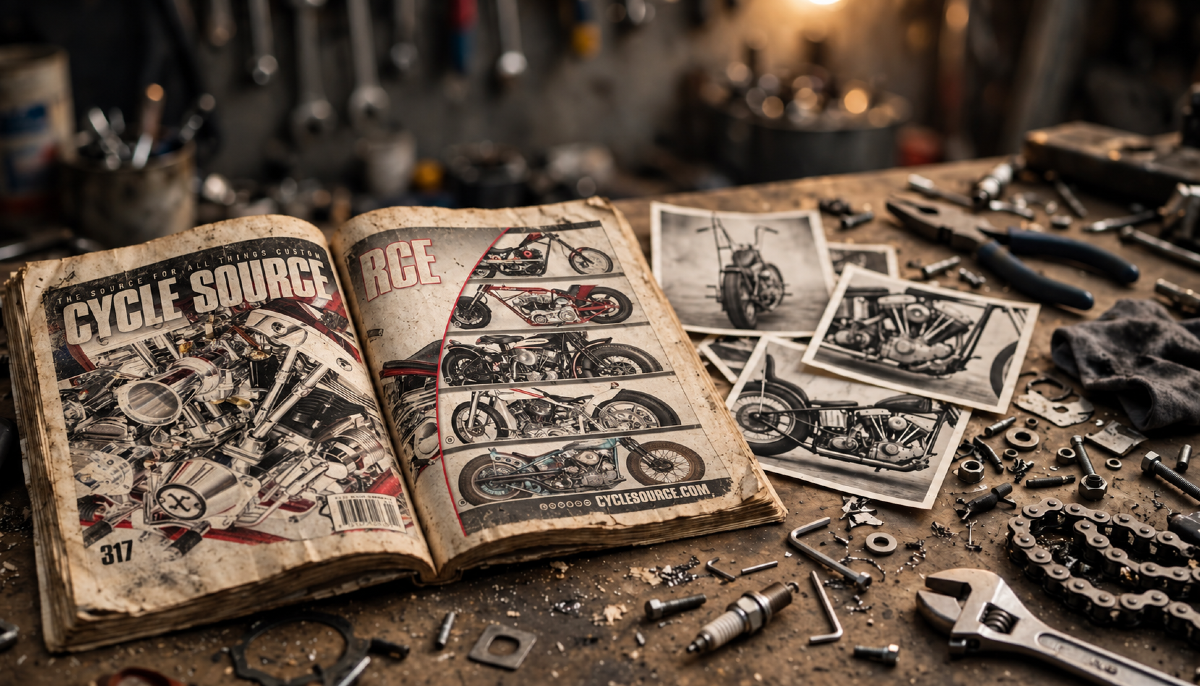
On S&S Cycle’s Proven Performance Podcast, Howard Kelly brings together Chris Callen of Cycle Source, Cary Brobeck of Choppers, and Jordan Mastagni of Hot Bike to talk about print magazines and the motorcycle culture they document.
Motorcycle magazines preserve the builders, custom bikes, and stories that shape riding culture. A motorcycle you scroll past today can become a build you study for years when its story makes it into print. A magazine gives that bike a lasting record, along with the builder’s story, careful photography, and details you can return to when you’re working on your own machine.
On S&S Cycle’s Proven Performance Podcast, Howard Kelly brought together our own Chris Callen, Cary Brobeck of Choppers, and Jordan Mastagni of Hot Bike to talk about what motorcycle magazines contribute. Their conversation starts with the people keeping those publications alive, then gets into the work that makes a printed feature worth keeping.
Cary Brobeck is the editor-in-chief of Choppers, which Ed Roth started in 1967. Brobeck describes it as the first lifestyle motorcycle magazine, a publication that gave the chopper scene a place of its own.
The title passed through different publishers and eventually went inactive. Brobeck brought it back around 2018 or 2019. Today, he keeps it going alongside a full-time job and with help from a small part-time team.
Our publisher, Chris Callen, started Cycle Source as a free newsprint circular around Pittsburgh, Pennsylvania. Its original distribution covered roughly a 100-mile radius, and the publication included four-color pages.
About eight years later, we reached national newsstands. During the conversation, Callen noted that our 30th anniversary was approaching that March. He also discussed his shorter runs publishing Trackside Report and Torque Magazine, along with our work in social media, streaming motorcycle discussions, and events.
Jordan Mastagni joined Hot Bike around 2005 or 2006. His introduction includes editor-in-chief, accountant, and lead janitor, a fair description of how many jobs an independent publisher takes on.
After working within a large publishing company, Mastagni purchased Hot Bike‘s rights and intellectual property in 2021. He relaunched the magazine in 2023 and has continued rebuilding a brand with more than 55 years of history.
Why Motorcycle Magazines Give Bike Features Staying Power
Brobeck’s first distinction is straightforward: a motorcycle can get attention online and disappear beneath the next day’s posts. A printed feature becomes something a reader can keep.
That difference matters to builders. Anyone can post a motorcycle on Instagram, but a six-, eight-, or ten-page magazine feature requires someone else to recognize the work and devote space to it. Brobeck still sees that recognition mean something to people who build bikes.
It also creates a practical problem for editors. He sometimes has to ask a builder not to publish an entire submitted photo shoot before the magazine comes out. Readers should still have something waiting for them when they open the issue.
For Mastagni, a feature once gave a finished motorcycle a clear milestone. A builder completed the bike, enjoyed it, earned a magazine feature, and then started thinking about the next project. He wants print to provide that sense of completion and recognition again.
Kelly puts considerable weight on the photographs. A phone makes it easy to share a bike immediately, but immediacy doesn’t guarantee good lighting, a useful angle, or thoughtful framing.
Magazine photography takes planning. The photographer decides how to show the motorcycle, and the layout places those images beside the words that explain them. Readers can study a detail, read about it, and look back without losing their place.
Kelly still follows that sequence himself: he looks through the photographs first, then returns to the story because he wants to understand the bike he’s seen.
A strong riding photograph also leaves room for the reader’s imagination. A bike leaning through a corner or dragging a peg prompts questions about speed, location, and what the rider was doing. Mastagni adds another part of that response: readers can picture themselves riding that motorcycle.
Kelly remembers readers tearing out photographs of motorcycles and hanging them above their workbenches. That page became a reference for a build that might take months or years, depending on when the owner could afford another part.
The inspiration didn’t always lead to a complete custom motorcycle. During the billet-parts years, a reader might see a bike by Matt Hotch or Arlen Ness, then replace the stock mirrors on their own bike with a set of Ness mirrors. That small change still connected the reader to something they’d seen in a magazine.
Technical articles offer another kind of bench-side reference. Kelly describes studying a printed photograph and caption, walking over to the motorcycle, and comparing the two. The magazine can stay open beside the job, with the tool size or part detail visible.
For him, usable detail is part of the value. A bike feature can provide an idea for a future build, while a technical story can help a reader understand what’s happening on the motorcycle in front of them.
Kelly’s Three Rules for Motorcycle Coverage
When Kelly interviewed for the editor’s job at Hot Bike, Steve Stillwell handed him old issues, a yellow legal pad, and a pen. He asked Kelly to write down what he’d change and said he’d return in 20 minutes.
He remembers the earlier coverage relying heavily on studio photography and static road-test images. His concern was that the magazine wasn’t showing the part of motorcycling that excited him most: riding.
A beautiful motorcycle still needed to function. Otherwise, Kelly joked, it might as well be a coffee table.
He recalls those changes at Hot Bike encouraging similar shifts in road-test coverage at Easyriders and American Iron. The point was to put actual motorcycle use into the photographs and stories, rather than treating appearance as the whole subject.
Print Brings Editorial Responsibility With It
Kelly’s attachment to magazines also comes from the responsibility of publishing information under a recognizable name.
During the height of the V-twin publishing boom, he remembers roughly a dozen publications competing for readers. Before the internet became a routine source of motorcycle information, those magazines carried considerable weight.
As online motorcycle discussion grew, Kelly saw people use aliases to make claims about products, companies, and other people. Meanwhile, a magazine working months ahead couldn’t answer every new argument in real time.
He associates print with editorial accountability, including the possibility of libel claims. His point is about the care he felt the job required: information would go onto a page, carry the publication’s name, and reach readers who expected it to be legitimate.
That expectation helps explain why he wanted the editors’ voices in this conversation. The people making the editorial decisions matter alongside the motorcycles they publish.
Digital Channels Let Print Do a Different Job
Callen admits that he once held the internet and social media in contempt as other magazines disappeared from newsstands. Although he was already experimenting with motorcycle video in the earliest GoPro years, the shift sometimes felt like losing something important.
Over time, he came to see each platform as a different tool.
A website can carry timely news. Social channels can handle quick updates, while email can deliver information directly. Because those channels do those jobs, a magazine doesn’t have to pack every page with news that may age before the issue reaches a reader.
Instead, print has room for longer stories, larger photographs, and a break from the constant flow of updates.
Mastagni takes a similar approach at Hot Bike. Time-sensitive material belongs on the website or social channels. The magazine gets the more carefully developed, lasting features, although parts of those stories can later reach other audiences online.
One Good Story Can Travel Through Several Channels
Callen’s commitment to print doesn’t limit where he shares a story. He says he’d keep publishing even if the readership came down to himself and five friends, but reaching people remains part of the job.
He uses a ShopTalk conversation with Tim Duffy as an example. Duffy is known for the photograph of him riding his motorcycle through the wreckage of September 11.
That conversation gave Callen an opportunity to hear and share part of Duffy’s life. Some of the material could appear in the magazine, some in the live discussion, and some in video clips, short social posts, or a blog article.
For Callen, the important thing is that the story travels. Different formats let people encounter it in different ways, then seek out more of the background.
That’s also why Kelly values the editors’ digital work. A brief encounter can lead someone to a full bike feature or a longer discussion when they want to understand more.
Keeping Every Channel Going Takes Time and Money
Mastagni would happily focus on one magazine if the business allowed it. Instead, he has to divide his attention among print, Instagram, Facebook, YouTube, and the other demands of publishing.
Each channel needs an approach that fits its audience. Producing all of them well means planning around the same limited hours in the day.
Brobeck feels that pressure, too. He describes Callen and Mastagni as further ahead in video and social media than Choppers, but his main limitation is bandwidth. A full-time job, part-time help, and a small budget put a ceiling on what he can produce.
For him, being on camera also doesn’t come as naturally as making a magazine. He respects the people doing useful motorcycle video, even while wishing he could spend more of his own effort on print.
Their disagreement with certain parts of social media isn’t a refusal to participate. They’re deciding where their time can produce work they care about.
Photo by Cycle Source
Born-Free Shows Why a Lasting Record Matters
Mastagni’s work with the Born-Free builders grew out of a problem he couldn’t ignore.
The show can bring together 30 extraordinary motorcycles. Yet someone who misses that weekend, or doesn’t follow the right social feeds during the next week or two, may never get a meaningful look at them.
He didn’t think that brief window did justice to the bikes or the builders. A substantial printed journal could preserve the work and give readers something they could revisit.
It also provides space for details that a short post struggles to carry: the builder’s background, problems during the project, decisions behind the finished motorcycle, and the parts that made it work.
Mastagni approaches that selection intentionally. Everything doesn’t automatically belong in the magazine. He wants the quality of the chosen work to encourage builders, photographers, contributors, and advertisers to want to be part of it.
Brobeck sees the Born-Free publication as a clear example of documenting history. Years later, a reader can open the book and see the motorcycles together without hunting through old feeds.
Back Issues Keep the Past Within Reach
Brobeck still looks through old Easyriders, The Horse, Cycle Source, Hot Bike, and Roth-era Choppers issues for ideas. Some retain the cigarette-smoke smell of the 1970s.
Those pages remain useful to him while he’s deciding what direction to take a frame or a build. The archive connects old motorcycles to work happening in his garage now.
He also raises a more extreme concern: if online access or cloud storage disappeared, a physical issue would still exist. The broader point is that readers don’t need a working feed, an active account, or an internet connection to open a magazine they already own.
The editors see today’s publications becoming objects people collect. Brobeck describes them as closer to coffee-table books than disposable issues, with readers stacking them on shelves and keeping them.
“Instagram, it records popularity, what’s cool, what’s now, and magazines record history.”
Cary Brobeck
Callen connects the present-day publishers to the people who helped establish enthusiast media, including Robert Petersen and Tom McMullen.
As he describes their philosophy, the starting point was finding someone who loved the subject. Writing, photography, distribution, and the mechanics of publishing could come afterward.
That order matters to him. The person making the magazine should already care about the motorcycles and the people around them.
He sees the return to small, enthusiast-led publishing as a continuation of that approach. Large companies once supported the work, but these editors now keep their titles alive because they want them to exist.
Brobeck’s own magazine has a similar origin. Callen points out that Roth’s Choppers gave names, faces, and motorcycles a place when mainstream media offered little room for that scene.
The same responsibility continues today: notice the people doing something of their own and give them enough space to explain it.
Our Stories Start With Ordinary Motorcycle People
When Kelly asks each editor to explain what makes their publication matter, Callen starts with his own experience of not fitting in.
He found a place among motorcycle people, including Vietnam veterans who helped him learn to care for himself and the people around him. Those relationships shaped the values he continues to bring to Cycle Source.
That’s why our stories look for real people who love their motorcycles and the families and friendships around them.
Callen doesn’t want every feature to depend on the largest budget, the biggest spectacle, or the most expensive motorcycle. His interest remains with regular nine-to-five people who put something of themselves into riding and building.
Mastagni expresses his own commitment through the depth of the work. He wants readers to understand a motorcycle, a builder, or a product beyond its first impression. Both approaches depend on taking the subject seriously enough to spend time with it.
Younger Readers Are Giving the Editors Encouragement
Brobeck still hears strong support from longtime readers. He mentions seeing Stacy McCleary in Sturgis, a magazine enthusiast who still uses a flip phone.
But he also reports more interest among younger riders.
For a while, Brobeck sold more hats than magazines. Merchandise helped pay photographers and support printing, but it bothered him because he wanted to publish a magazine, not become a hat company.
During the year of the conversation, he saw that balance change. Magazine sales rose enough that he increased the print count, and younger Sportster riders were among the people giving him feedback.
That matters for a publication with a narrow advertising market. A magazine centered on older motorcycles and choppers can’t automatically appeal to every large modern-bike advertiser. Brobeck mentions companies such as Biltwell and Espinoza as part of that more limited pool.
Mastagni also hears from younger readers who have researched Hot Bike‘s history. For him, that interest provides reassurance when the workload makes him wonder whether people still care.
These are the editors’ observations about their own readers, rather than a claim that every motorcycle magazine is experiencing the same result.
Readers Want Something Away From a Screen
Callen describes part of that interest as digital burnout. Younger generations have grown up surrounded by technology, and he sees some looking for experiences that let them step away from it.
The examples in the conversation are practical and familiar: camping, Lego, vinyl records, and magazines.
Mastagni sees a similar attraction to getting something in the mail. His son enjoys receiving a Lego magazine and looks forward to its arrival.
He also connects the interest in physical publications with younger people going out, attending concerts, and participating in hobbies that require them to leave the screen behind. Motorcycling fits that preference because it asks people to get outside and do something.
For these publishers, a magazine is another part of that hands-on experience. It gives the reader a way to stay connected to motorcycles without requiring another session on a device.
Photo By Hot Bike
The Next Generation Has Its Own Motorcycle Culture
Brobeck’s interest in younger Sportster riders prompts Callen to make another point: today’s stunt riders deserve attention.
He sees riders on Sportsters, Dynas, and FXRs doing wheelies, wearing out tires, damaging bikes, and putting them back together. Their motorcycles and style differ from what earlier chopper riders preferred, but he recognizes the same desire to do things their own way.
Callen believes magazines would miss an important part of the culture if they ignored those riders.
That connects directly to his view of Choppers‘ history. Roth’s magazine existed because a group of motorcycle people needed a place to show what they were doing. New groups can deserve the same attention without copying the old look.
Brobeck jokes that he may need to include more Sportsters. Underneath the joke is a real editorial consideration: a publication can respect its history while paying attention to the people riding now.
Generation X Can Want More Than One Kind of Bike
Callen believes the motorcycle industry overlooked Generation X while moving its attention from baby boomers to millennials.
In his view, Gen X riders have reached years when some have both the money and the time to pursue motorcycling more fully. That can include a modern touring motorcycle for a cross-country trip and a separate custom or performance bike for shorter, harder riding.
Kelly pushes back on behalf of S&S, saying the company hadn’t ignored that generation. However, Brobeck agrees with Callen’s broader criticism of the industry.
Brobeck also sees room for manufacturers to correct earlier decisions and pay more attention to middle-aged riders. He’d just ridden roughly 600 or 700 miles on his chopper over a weekend and was still sore. A newer motorcycle had an appeal of its own.
Nate makes a similar distinction in his assessment of the newer Super Glide. He loves old-school choppers, but he doesn’t want one for every outing. The Super Glide’s 1970s-inspired appearance appeals to him, while its newer suspension and ride modes suit the canyon riding he also enjoys.
Those preferences can coexist. Owning a comfortable, modern motorcycle doesn’t eliminate the desire to build something personal.
Motorcycle Styles Cycle, but Simplicity Keeps Its Appeal
Kelly has watched the industry move through periods he describes by their defining equipment: drag pipes, fishtails, Thunderheaders, and big stereos.
He views those changes as part of an approximately 20-year cycle. In his telling, choppers lead into Pro Street motorcycles, then baggers, then the next popular style before attention turns back toward choppers.
Brobeck and Callen immediately challenge the idea that choppers need to “come back.” As they see it, choppers never left.
Kelly’s larger point concerns simplicity. After increasingly elaborate electronics, key fobs, navigation, and entertainment systems, he believes some riders will want a rigid frame, engine, primary, rear fender, and gas tank they can assemble in a garage.
He also recalls earlier riders experimenting with straight pipes and changes to their exhausts to improve how the bikes ran. That history matters to him because the motorcycle remained something an owner could work on and understand.
The magazine gives that kind of project somewhere to begin, with photographed builds, technical information, and advertisers supplying parts.
Useful Motorcycle Creators Deserve Credit
Brobeck’s criticism of influencer marketing includes an important distinction. He respects creators who ride, understand the scene, and share information that gives something back to motorcycling.
He puts Callen and Mastagni in that category. Their videos and events extend work they already do within the community.
Callen agrees that some online creators educate and entertain well. He names Cleetus McFarland as someone whose work he enjoys.
Their frustration concerns content that appears disconnected from the motorcycles themselves. Brobeck describes creators moving among manufacturers and gear companies without the same lasting commitment he sees in enthusiast publishers. Mastagni adds that constant praise can start to feel less believable when every product is supposedly wonderful.
Callen also points to online controversy surrounding Harley-Davidson as an example of coverage he felt pursued outrage rather than helping riders.
Kelly makes his own position clear: during his two years back at S&S, he hadn’t paid a single influencer. He still recognizes that some people produce good work. The conversation’s criticism is about purpose and authenticity, rather than dismissing everyone with an online audience.
Audience Size Doesn’t Explain Who You’re Reaching
Callen learned to discuss target audiences when Cycle Source was still a local newsprint publication.
Businesses would tell him they advertised in a newspaper reaching 400,000 people. His response was to examine how many of those readers belonged to the business’s motorcycle audience within its service area.
He applies the same reasoning to social media. A large impression count or a stream of likes doesn’t explain whether the audience wants motorcycle parts, attends motorcycle events, or will become committed riders.
Brobeck uses the SmokeOut as a contrasting example. People attend because they’re interested in motorcycles and the scene around them. A sponsor’s banner reaches an audience that has already chosen to participate.
Callen’s test goes further than an immediate sale. He wants to know whether the media helps create lifetime motorcyclists.
He also compares the lasting influence of publishers with the recognition of today’s online personalities. His references include MrBeast and Larry Flynt, but his motorcycle examples return to Ed Roth, Tom McMullen, Robert Petersen, and the people whose work shaped enthusiast publishing over decades.
Advertising Can Fund the Community Around the Magazine
Brobeck’s argument about advertising dollars extends beyond paying for printed pages.
He describes a hypothetical $10,000 sponsorship going to a motorcycle publisher. That money can help pay photographers, event workers, bands, DJs, and other costs of bringing people together.
Because all three publishers run events, sponsorship supports work beyond the magazine itself. Brobeck names the SmokeOut and the Hot Bike Tour as examples of the activity he values.
He doesn’t pretend those commitments are cheap. Merchandise, advertising, and sponsorship can help cover photography bills, limited ad revenue, and issues that lose money in print.
Mastagni believes some advertisers and readers are becoming more skeptical of generic influencer promotion. Brobeck sees a similar shift and hopes it will redirect support toward people producing substantial motorcycle work.
They present that shift as something they’re noticing, not as a measured industry-wide result. Their shared argument is that a publisher’s budget can support a wider group of people who keep the scene active.
A Print Ad Can Stay in Front of a Reader for Years
Kelly explains why S&S values magazine advertising even when the return is difficult to measure.
An online ad can disappear quickly. A printed ad stays with the issue, which may remain on a workbench or shelf for a week, a month, a year, or five years.
That shelf life fits the way many people build and modify motorcycles. A reader may see a part they want but need six or nine months before they’re ready to buy it.
The magazine keeps the advertisement available during that delay. It can continue introducing the company and its product each time someone returns to the issue.
Kelly doesn’t claim S&S can calculate every result. Instead, he values remaining in front of a relevant audience over time.
The editors make a similar point about events. A sponsor can reach people who already care about motorcycles, even if that relationship doesn’t produce an immediate, easily measured purchase.
Near the end of the conversation, Brobeck says people regularly ask him about starting a magazine. He, Callen, and Mastagni are willing to help.
That turns into a joke about a magazine-publishing book Callen sent him. Its advice begins with preparing a business plan and talking to investors, which gets a laugh from publishers accustomed to working with far less formal backing.
The joke follows a serious commitment. Each editor has accepted the workload because the publication matters to him, even when the finances don’t resemble the old large-publisher model.
Mastagni remembers people questioning his decision to relaunch print in 2023. He wanted to do it anyway because he appreciated the format and believed other readers did, too.
Callen’s promise to keep publishing for himself and five friends expresses the same attitude. These magazines continue because the people behind them want the stories to have a home.
Where to Find the Magazines
The editors close by explaining how readers can get their publications and follow their other work.
Brobeck points readers to the Choppers Magazine website and its Choppers Magazine Instagram presence.
Our Cycle Source magazine website is the hub for issues, subscriptions, and our other motorcycle coverage. Callen also names Barnes & Noble, Books-A-Million, and Walmart as our three retail distribution points, with Cycle Source accounts across social media.
Mastagni directs readers to the Hot Bike magazine website. He also names Barnes & Noble and Books-A-Million, along with the magazine’s Instagram, Facebook, and YouTube channels.
Kelly confirms that readers can subscribe through the publications’ websites. He also points out that subscribing costs less than buying individual issues on the newsstand and brings the magazine directly to the reader.
How Motorcycle Magazines Keep History Within Reach
Callen closes the central argument by explaining what publishers add to the moments people see online.
“We explain why those moments matter.”
Chris Callen
A feature gives a motorcycle context, explains the builder’s decisions, and places the work within the culture around it. The printed issue keeps that account available after the event ends or the feed moves on.
Digital channels help those stories reach people. The magazine gives readers a record they can return to, whether they’re remembering a rider, studying a build, or opening an old issue beside their own motorcycle.
Want these stories on your workbench instead of buried in a feed? Subscribe to Cycle Source Magazine and keep custom motorcycle culture within reach.
This is an example of a text widget which can be used to describe a particular service. You can also use other widgets in this location.
Examples of widgets that can be placed here in the footer are a calendar, latest tweets, recent comments, recent posts, search form, tag cloud or more.