

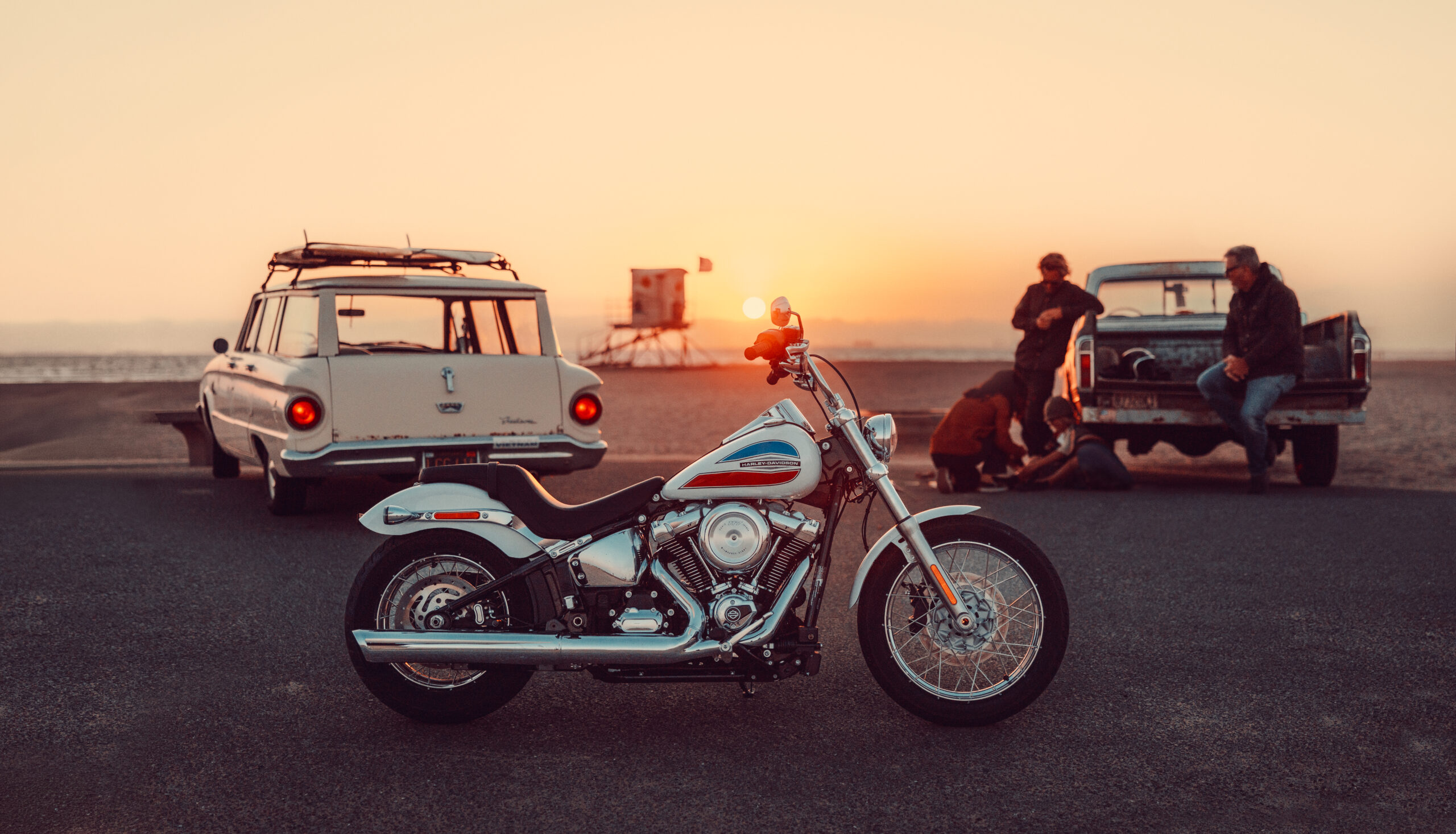
If you love the 1971 Superglide’s look but want a bike that feels ready for canyon roads, the 2026 version makes a strong case. On his first ride, Nate Beck found it more aggressive than its vintage styling led him to expect.
His reservations are small: the seat might need an upgrade for long trips, and he’d change one detail on the rear fender. The bigger question is how much of the original Harley could bring back while keeping the price at $16,000.
The 1971 Superglide behind the new bike
The 1971 FX Superglide was Harley-Davidson’s first factory custom. Willie G. Davidson blended the sporty XL series with the larger FL platform at a time when the company was looking to shake things up. Its boat tail became one of the most recognizable, and debated, parts of the design.
Nate sees the 2026 Super Glide as another turn toward Harley’s history under new leadership. It wears paint inspired by the ’71, and each tank is serialized. Harley plans to make 2,500 bikes, so this is a limited tribute rather than a full-time return.
Modern muscle under the old-school look

The new Super Glide runs a 117-cubic-inch Milwaukee-Eight rated at 98 horsepower and 120 foot-pounds of torque. Those figures appear in Harley-Davidson’s Super Glide specifications, but the equipment goes well beyond the engine.
ABS, traction control, drag-torque slip control, and tire-pressure monitoring come standard. Road, Rain, and Sport ride modes give the rider another way to adjust the bike’s character. Nate also points to the modern suspension as part of the appeal for someone who likes vintage Harleys but wants a newer ride.
The first ride feels more aggressive than the styling suggests
Nate expected an easygoing cruise. Instead, the riding position caught his attention right away. The seat holds him in place, the mid-mounted pegs put his feet in an assertive position, and the mini-ape bars feel to him more like T-bars.
A seaside ride was relaxed enough, but he kept thinking about canyon roads. Sport mode only added to that urge. What surprised him most was how eager the Super Glide felt in the twisties while still looking like a bike with roots in the 1970s.
Paint, chrome, and the details Nate kept noticing
Nate credits the design’s smaller decisions for making the bike work. White Onyx Pearl paint gives the five-gallon tank a deep glimmer, while the branding stays subtle. The Superglide logo and skinny rear end help pull the nostalgic shape together.
Then there’s the chrome. Nate calls out the externally laced rims, their hubs, and the polished pieces across the bike, especially how they catch the sunlight. He also notes the two-into-one exhaust’s connection to the original ’71. For him, those details do more than the broad paint scheme alone to make the tribute convincing.
Two details he’d change
The seat works for Nate’s riding position and feels fine for a day trip. For a 200- or 300-mile day, especially as part of a multi-day ride, he’d consider something softer.
His other gripe is visual. On the original ’71, red pinstripes ran along the sides of the rear fender, with blue higher up. The 2026 bike puts the striping down the center to match the front fender. Nate wonders how a closer match to the original would have looked, though he acknowledges Harley’s designers may have tried it. Neither issue spoils the bike for him.
Who gets the most out of this Super Glide?
Nate’s an old-school chopper guy, but he doesn’t want to ride a chopper every time. A knucklehead isn’t necessarily the bike he’d choose when he wants to push through canyon corners.
That’s where he thinks the Super Glide fits. It has the old-school Americana look he loves, along with ride modes, newer suspension, and road manners that encourage a harder ride. For someone who wants that combination, he struggles to name much he’d change.
How faithful does a reissue need to be?

After the bike appeared, Nate saw commenters argue that it couldn’t be a real Superglide without external rear shocks or the original’s oval air cleaner. The new bike uses a round one. He understands the comparison, but those aren’t his objections.
His point is practical: retooling a factory to reproduce those parts for a run of only 2,500 bikes could push the price much higher. A more exact replica might please some riders, yet lose others who object to the cost. Nate would rather see Harley work with what it has and keep the bike within reach. The serialized Super Glide production run makes that trade-off especially relevant.
Nate’s verdict on the $16,000 Super Glide

The 2026 Super Glide gives Nate the look he wanted and a ride he didn’t expect. At the stated $16,000, he considers it a strong buy, even with his seat and pinstripe complaints.
With only 2,500 planned, his recommendation is to see one at a local Harley-Davidson dealer if you’re interested. For Nate, the tribute works because it’s a motorcycle he’d want to ride hard, not just admire.


