

Article And Photos by Josh Elzey – TWIG Photography
There are plenty of motorcycle events you can ride to over the course of a year, but only a handful make you feel like you’ve stepped through a crack in time. The Race of Gentlemen is one of those places.
Every October, Wildwood, New Jersey, transforms into something you just don’t see anymore. Flathead Fords roll through town beside Knuckleheads and Panheads. Riders wearing pudding bowl helmets and engineers boots cruise streets lined with vintage motels that haven’t changed much since the 1950s. It isn’t a reenactment or a costume party. It’s a weekend dedicated to preserving the spirit of early American hot rod and motorcycle culture, and somehow it feels completely authentic.


For a lot of people, though, the weekend really begins Friday night.
Night of the Troglodytes has become the unofficial kickoff to TROG, and if you’re into choppers, it might be the best part of the entire weekend. Held at the Lazy Bass Bayside Bar & Grill in North Wildwood, NOTT brings together some of the finest pre-1976 motorcycles in the country. Panheads, Knuckleheads, Shovelheads, pre-units, survivors, long bikes, outlaw chops, and garage-built customs fill the lot as the sun starts dropping over Grassy Sound.


The setting couldn’t be better. Boats drift through the marina, open pipes echo off the water, bands play into the evening, and motorcycles continue rolling in until long after the party has started. It’s less like a motorcycle show and more like someone invited every chopper builder you know to the same backyard barbecue.
What I love most about NOTT is that nobody is in a hurry. Builders stand beside their motorcycles all night, talking fabrication, old swap meet scores, and the stories behind the parts. Walk up and ask about a handmade oil tank or an unusual frame modification, and chances are you’ll hear the whole history of the build. That’s how knowledge gets passed along in this culture. It doesn’t happen through trophies or social media—it happens standing in a parking lot with a cold drink while somebody points to a weld they aren’t quite happy with.


The motorcycles themselves are worth the trip. Every pass through the rows reveals something you missed the first time. A molded frame. A Frisco-mounted tank. Rabbit-ear handlebars. A perfectly weathered Wassell tank. A set of handmade pipes that look like they belong on the motorcycle because they’ve been there for decades. None of these bikes were built to chase internet trends. They were built because somebody had a vision and enough determination to see it through.
By the time the music winds down, everybody knows tomorrow is race day.


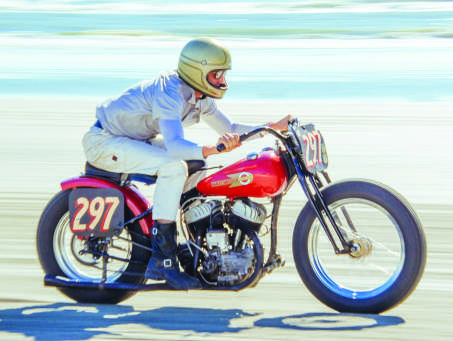
Saturday morning shifts the entire vibe. The beach comes alive as racers unload motorcycles that look like they rolled straight out of the late 1930s and early ‘40s. The rules are simple: if it wouldn’t have raced back then, it doesn’t race now. That means pre-1948 American motorcycles and traditional hot rods built to honor the era that inspired the event.
Standing in the pits is almost as entertaining as watching the racing itself. Racers wrench in the sand, making last-minute adjustments while spectators wander through the paddock asking questions and admiring machines that normally spend their lives hidden away in garages. There’s no velvet rope separating the crowd from the racers. If someone is rebuilding a carburetor or changing gearing between runs, you can stand right there and watch.


Then the racing starts.
There’s nothing refined about dragging motorcycles down a beach. Tires fight for traction, sand sprays high into the air, engines scream at full song, and riders wrestle eighty-year-old motorcycles toward the finish line. Nobody is chasing national records. They’re chasing history.


This year’s weather couldn’t have been much better. Favorable tides opened up plenty of racing surface, giving motorcycles and hot rods room to do what they were built to do. Thousands of spectators lined the course while live music filled the background throughout the weekend. Between the racing, the boardwalk, the swap meets, and the nightly gatherings, there was never much reason to leave the beach.
Brian Cannon once again took top honors in the Big Twin class aboard his Harley-Davidson 50A, proving once again that preparation and consistency still matter, even on sand.


What continues to impress me about TROG isn’t necessarily who wins. It’s the people willing to dedicate countless hours building and maintaining these motorcycles simply for the chance to make a few passes down a beach. These aren’t museum pieces sitting under lights. They get ridden. They get raced. They break. They get fixed. Then they come back next year to do it all over again.
That’s becoming increasingly rare in today’s motorcycle world.


As a photographer, TROG is almost overwhelming. Every direction you turn offers another perfect frame. Early morning fog drifting across the beach. Salt spray hanging in the air behind a flathead. A weathered Panhead glowing in the evening sun at NOTT. Kids watching vintage racers with the same excitement their grandparents probably had seventy years ago. It’s impossible to leave without a memory card full of images, but even then the photographs only tell part of the story.
The real story is the people.


Builders sharing ideas. Racers helping each other stay on the course. Friends reconnecting after another year apart. Young riders studying old motorcycles while experienced builders happily answer every question. That’s the culture David Mann painted decades ago, and somehow it’s still alive on the beaches of Wildwood.
Maybe that’s why The Race of Gentlemen has become more than a race and Night of the Troglodytes has become more than a Friday night chopper show. Together they represent something many of us are afraid of losing—a motorcycle culture built on craftsmanship, friendship, and the simple idea that motorcycles are meant to be ridden, not hidden.


As long as there are people willing to kick old Harleys to life, line them up on the sand, and spend an October weekend celebrating the machines that built this lifestyle, Wildwood will remain one of the most important stops on the motorcycle calendar.
I’ll see you on the beach.


