


From Issue 319 Of Cycle Source Magazine. See The Entire Digital Issue HERE Or Subscribe HERE Today And Get A Real Magazine In Your Grubby Little Hands Each Month!
Article By And Photos By: Oliver Touron

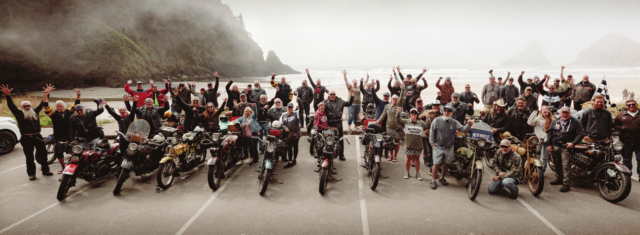
In September 2025, some thirty riders rolled out from the Atlantic coast of the United States, in North Carolina, for the very first edition of a two-week endurance race across the country, bound for the Pacific coast in Oregon. What set this adventure apart was a simple, uncompromising rule: every motorcycle on the start line was one hundred years old, or more.
Back in May 1915, twenty-six-year-old Effie Hotchkiss set off across America by motorcycle, accompanied by her fifty-six-year-old mother, Avis. Riding a Harley-Davidson Model 11-F fitted with a sidecar, they crossed the country from the East Coast to the West, Effie becoming the first woman in history to accomplish such a feat. They carried with them a flask filled with Atlantic Ocean water, which they poured into the Pacific upon arrival, a symbolic gesture marking the completion of their journey.
On September 3, 2025, in North Carolina, Sean Jackson evoked that historic ride on the eve of the start of the inaugural TransAmerican Motorcycle Endurance Run, aka TransAm, an endurance race spanning the continent, reserved for motorcycles one hundred years old and older. A young, passionate mechanic and a rider of old machines himself, Jackson is the driving force behind the event, alongside his wife Kelsey, who handled logistics and communications, and Tom Banks, also a rider and well known in the U.S. for his collection of antique motorcycles.


In 2021, Jackson and Banks took over Competition Distributing, a company founded in 1968 by Lonnie Isam, specializing in the restoration of pre-1936 motorcycles, particularly Harley-Davidsons, and in the manufacturing of replacement parts. Lonnie Isam’s son, Lonnie Isam Jr., had launched the now-famous Motorcycle Cannonball in the late 2000s, a race very much in the same spirit as the TransAm. After his death in 2017, the Cannonball was taken over by his friend Jason Sims, who ran it through 2023, a race I documented myself as a staff photographer. The 2025 edition was unfortunately canceled. To fill that void, uncertain whether it signaled the end of this prestigious event, and to give owners of these venerable machines a new opportunity to pull them out of their garages, Jackson and Banks decided to create their own race. It did not hurt that they also manufacture most of the parts required to keep these motorcycles running. As ever, you are best served by yourself.
The world of antique motorcycles is a small one. Owners all know each other, more or less, forming a true tribe. Among themselves, they prefer to call one another caretakers of these beautiful machines, which they preserve with near-religious devotion. On the starting line of the first TransAm, there were many kinds of teams: families, solo riders, groups of friends, coming from all across the United States, and even a team that had traveled all the way from Italy.


Engines had to be one hundred years old or more, built before 1925. While not every motorcycle was entirely original and many featured parts from other eras, the heart that powered them was genuinely centennial. Twenty-three Harley-Davidsons, mostly J Models, made up the bulk of the field. As a nod to Effie Hotchkiss and her mother, one team paired a father and daughter, Bill Page and Amy, riding a 1925 Harley-Davidson JD sidecar.
The oldest Harley in the race, a single-cylinder 1911 Model 7A, was piloted by Dave Currier, a veteran of this kind of competition, second overall in the 2023 Cannonball and winner of the 2021 edition. The only Indian in the field, a 1924 Scout, came from Italy, ridden by Samuele Reali. Five Hendersons, one dating back to 1913, formed the second major group, though one of them, a 1929 model, rode only in solidarity, not eligible for the title due to its relative youth. Nicknamed the Wolf Pack, they rode together and were often at the front of the race.


Mitsuhiro “Kiyo” Kiyonaga and Cat Diamond Kiyonaga, an American-Japanese couple, chose a different approach. She rode a 1910 single-cylinder Thor, the oldest motorcycle in the race, while he piloted a magnificent yet fragile 1919 Excelsior. Completing this rolling museum was a rare 1924 Ace, ridden by Jeffrey Tiernan.
As with any transcontinental race of this nature, and given the age of the machines, stage planning was critical. Sean Jackson rode the proposed route several times himself, while his wife Kelsey organized lodging and meals at every stop for riders and their support crews. On the road, competitors were largely on their own; at the end of each stage, they could rely on their mechanics and moral support teams. Daily distances ranged from roughly 200 to 310 miles. On motorcycles of this vintage, that is no small task, for either the machines or the bodies riding them.
Breakdowns were expected, and plentiful, ranging from simple flat tires to more complex issues with ignition, compression, or carburetion. On the road, riders were allowed to help one another. The organization had nonetheless planned for contingencies, deploying two “flying mechanics”: Sean Jackson himself, assisted by Connor Levenson, traveling on brand-new Indian Pursuits (a Challenger and a Chieftain). Both experts were capable of diagnosing and addressing virtually any mechanical or electrical problem.
The full route covered 3,714 miles. The caravan crossed nine states: North Carolina, Tennessee, Kentucky, Missouri, Kansas, Colorado, Utah, Idaho, and finally Oregon. Along the way, it rolled through some of the most spectacular landscapes America has to offer, and along some of its most iconic roads: the Tail of the Dragon in Tennessee, with its 318 curves in under 11 miles; the roller-coaster roads of the Ozarks in Missouri; the endless straight lines of the Great Plains; Rocky Mountain passes topping 10,000 feet; a detour through the sublime Monument Valley in Utah; and, to finish, the legendary Pacific Coast Highway 1 in Oregon.


The group also visited several of the country’s most renowned museums: Wheels Through Time, Twisted Oz, and the Legends Motorcycle Museum, where they could admire, among other treasures, the 1915 Cyclone board-tracker that fetched a record $1.3 million at the Mecum Las Vegas auction in January 2025. The most staggering stop, however, was undoubtedly the Evergreen Aviation & Space Museum in McMinnville, Oregon. There, riders had the honor of parking their motorcycles beneath the wings of the colossal Spruce Goose, immortalized in Martin Scorsese’s The Aviator, on which Joe Petrali, the legendary Harley rider of the 1930s and two-wheel speed record holder, had served as an engineer for its single flight.
As a photojournalist accustomed to covering endurance races of this kind, I found in this inaugural TransAm all the defining traits of such extraordinary events. Participants honor their machines, maintain them with passion, suffer alongside them, celebrate every trouble-free mile, and love sharing it all with their peers, whom they consider a second family. Weather adversity, the group experienced every possible temperature and condition while crossing the continent, challenging terrain, technical failures, physical exhaustion: nothing weakened their determination to see it through. Each trial only further bonded the community. It is the individual and the machine, but with a powerful collective spirit. A true lesson in life.
Not everyone completed the entire route. Only eleven riders achieved a perfect score. Based on the ranking system, tied to the age of the motorcycle (and of the rider, in the event of a tie), the winner was Michael Butts, a physician, aboard his 1913 Henderson, followed closely by Frank Westfall on a 1914 Henderson Model C, and Erik Bahl on a 1915 Harley-Davidson 11-F. Brianna Meisinger was the top-placed woman, finishing fifth on her 1920 Harley-Davidson JD.
Rodney Sterling, on a 1919 Harley-Davidson Model J, finished twelfth, narrowly missing a perfect score after losing 27 miles on the first day due to a mechanical issue. Tyler Goletti never gave up. A breakdown on day one prevented him from starting and could easily have ended his race. Instead, he returned on day four, suffered another setback, came back again on day nine, and ultimately completed all remaining stages, winning one outright, on his 1921 Harley-Davidson Model J.


Kat Kiyonaga, on her 1910 Thor, completed only four of the fifteen stages, but she never quit, smiling through every circumstance. The same spirit defined her husband Kiyo, whose Excelsior eventually gave up despite every effort from this Los Angeles-based master engine builder, a cracked cylinder brought his race to an end. Italians Luca Geron, on a 1925 Harley-Davidson JD, and Samuele Reali, the only rider on an Indian, a 1924 Scout G, also completed every stage, often arriving last. By choice: they took the time to travel, to look around, and to fully savor their North American experience.
On September 19, 2025, the caravan parked at the foot of the Heceta Head Lighthouse in Devil’s Elbow State Park, near Florence, Oregon. Riders walked down to the Pacific surf and poured out small containers filled with Atlantic water, collected just before the start near Jennette’s Pier in Nags Head, North Carolina. No one was surprised when Samuele Reali jumped fully clothed into the icy waves, overwhelmed with joy at having made it to the end.
After riding 3,714 miles across the United States on their ancestral machines, they paid tribute, in their own way, to Effie Hotchkiss and her mother, their illustrious predecessors, and rightly celebrated the completion of a remarkable achievement.


The next TransAm will take place in September 2027. According to my information, the route will follow northern roads. Registration is open, but hurry. Spots are limited