


Some motorcycle shows chase noise. This episode of Shop Talk stayed locked on the good stuff, long miles, old iron, family, and the people who keep the culture alive.
Episode 347 moved from rally updates and a coast-to-coast ride plan to one of the most honest guest conversations the show has had in a while. If you care about custom choppers, real shop life, and why riding still clears your head better than anything else, there was a lot here worth keeping.

Shop Talk still feels like a Sunday night garage hang
Part of what makes Shop Talk work is that it doesn’t pretend to be polished in the corporate sense. It starts like a garage starts, with busted chops, weekend stories, caffeine problems, and comments flying in from everywhere. Chris Callen and the crew reminded viewers that the show streams across a long list of social channels, and if you’re watching live, you’re not stuck being an observer. You can jump in.
That tone carried through the whole night. There were shout-outs to riders checking in from around the country, talk about a good weekend at the Big Pines Run, and stories from Geneva-on-the-Lake, where the crew got together with friends for a birthday weekend. Those small details matter because they tell you what this show is built on. It isn’t only studio talk. It’s rooted in rides, events, and the people who show up.
The same thing came through in their Laconia recap. Chris and Mark talked about how crowded it was, how long it had been since they’d seen real lines getting into Weirs Beach, and how many younger riders showed up. That part stood out. Laconia wasn’t only full, it felt alive. They also praised the stunt competition put on by the Infinity Originals crew, which brought in dozens of riders and gave the rally a different kind of energy.
Then there was Party at the Pen, which set up the night’s guest conversation. The hosts had already spent time with Drew Huddleston there, and they made it clear that the best part of events like that isn’t only the bikes on display. It’s the conversations that happen while you’re walking around them.
America 250 is a fast, ambitious ride with a bigger purpose

The biggest announcement of the night was “America 250,” a cross-country ride built around the nation’s 250th birthday. Chris laid out the idea in plain language. He wanted to push back against all the constant division, inside and outside motorcycling, and put the spotlight on what still brings people together. The broader America 250 celebration already has people thinking about the anniversary, and the AMA’s America 250 program shows that riders are part of that story too.
Their route is loaded with stops that are meant to say something about the country:
- Ellis Island and the Statue of Liberty
- The Liberty Bell and the Washington Monument
- The St. Louis Arch and the start of Route 66
- Harley-Davidson headquarters
- Mount Rushmore
- Yellowstone National Park
- The Golden Gate Bridge
- The Hollywood Sign
- The Santa Monica Pier, the official end of the Mother Road
This isn’t a luxury bus tour. Chris said it outright, they’re a mom-and-pop operation, and if they’re going to do a trip like this, it has to move fast. The plan gives them nine days. Heather was flying into New York to meet Chris, and one of the first stops was Ellis Island, where she hoped to look up the family members who came through there in 1901 and 1902. That detail gave the whole plan a lot more weight. This isn’t only about landmarks. It’s about roots.
They also made room for the smaller stuff that gives a place its flavor. Philadelphia isn’t only the Liberty Bell. It’s also a cheesesteak argument. A cross-country ride like this has room for monuments, mom-and-pop food stops, and the kind of roadside detours that tell you more than a brochure ever will.
The crew also promised nightly YouTube updates, steady social clips, and a full documentary at the end. They know their travel style can drift into Clark Griswold territory when deadlines pile up, but they also made it clear they want to do the trip justice.
Josh Allison’s Oscar Mike Foundation bike carried real meaning
Before Drew came on, the show highlighted one of the most thoughtful bikes of the night, the motorcycle on the cover of Cycle Source issue 320. It was built by Josh Allison of American Metal Customs and American Metal Whiskey, and it was created for the Oscar Mike Foundation.
Josh described it as one of the most meaningful builds he has ever done. The bike honors wounded veterans, the work of the Oscar Mike Foundation, and America’s 250th birthday. What made it stand out was the way the theme stayed integrated into the machine instead of sitting on top of it.
Military challenge coins were worked into the bike to honor multiple branches, including the Navy, Coast Guard, and Marines. A boot knife was incorporated because it mattered personally to Noah from the foundation, who had served in Afghanistan. Josh also used parts of a Marine ceremonial sword in the build. The blade, handle, and hand guard were reworked into separate pieces, including the air cleaner cover.
That could have turned into a heavy-handed theme bike in a hurry. Josh said he worked hard to keep it from feeling cheesy, and that was the right instinct. The result sounded elegant instead of forced. It was a tribute bike, but it still had to work as a motorcycle.
He also gave love to Mama Tried, where the bike was shown. His take on that event lined up with the rest of the episode. The scene works best when ego gets left outside and the focus stays on the shared love of motorcycles.
Drew Huddleston built Evolution Cycles 618 the hard way
Drew Huddleston of Evolution Cycles 618 came in with the kind of story that keeps you listening. He isn’t a guy trying to sell a polished legend. He’s open about mistakes, open about luck, and open about the people who carried him when things went bad.
His path into motorcycles started differently than most. It wasn’t his dad who got him into bikes. It was his mom. She went to work at a Harley dealership, and Drew would hang around the shop watching bikes come and go. One day a chopper rolled in, and that was it.
That wasn’t the only surprise in his background. As a teenager, Drew played at a high level in soccer and made a US international team that traveled to Europe. He spent part of a summer in Amsterdam and played teams from places like Ireland and Laos. That’s a long way from a welding bench in Illinois, but it fits his personality. He said he wants to try everything, and his life backs that up. He has worked as a private investigator, fought MMA, chased drag racing, and taught himself shop skills because he had to.
The turning point came during a divorce, when money was gone and life was thin. His brother bought him a 2003 Sportster so they could ride together. Drew and the woman who would become his wife spent their first year together living in his brother’s basement. He opened a detailing shop so he could learn motorcycles up close, bought a cheap welder off eBay, and started figuring things out.

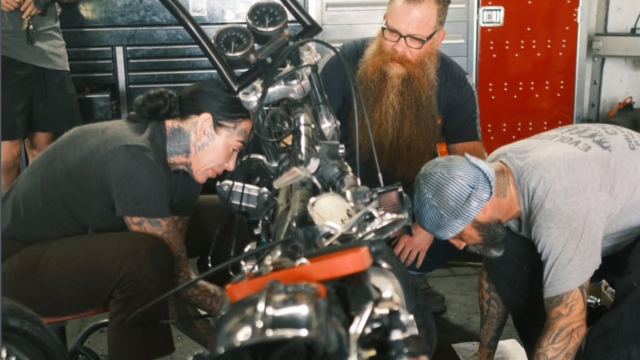
He did apprentice at a local shop, mainly because he wanted more fabrication time. Still, most of what he became came from obsession, memory, and repetition. If a transmission blew up, he learned to build a transmission. If a bike needed wiring, he wired it. If he saw something once, he could usually reverse-engineer it later.
The kitchen Panhead story says a lot about who he is
The story that summed him up best involved rebuilding a Panhead engine in his kitchen.
It got cold. His shop was full. He unplugged the home cameras, carried the engine into the house, rolled it into the kitchen, and put a rug underneath it. His wife found out early, called him on FaceTime, and told him to get it out. He replied that a Pan belongs in the kitchen.
Then it got better. Or worse, depending on where you were standing. Around 4:00 a.m., while everyone else slept, he finished the motor and fired it up inside the house. His daughters came running out of their rooms while the place filled with smoke and carbon monoxide.
That story is funny because no one got hurt. It’s memorable because it fits everything else Drew said. He is wired to try, wired to fix, and wired to push. That stubbornness shows up in his bikes, but it also shows up in the way he talks about family and responsibility.
The people behind Drew matter as much as the motorcycles


One of the strongest threads in the episode was how often the conversation came back to women, not as background figures, but as the people holding the whole thing together.
Drew talked about his wife without trying to sound slick. She believed in him when the money was bad. She sat in the garage and ate dinner off a Harbor Freight lift while he learned to wrench and weld. She backed him when the shop nearly broke them, and she was also tough enough to tell him to stop feeling sorry for himself and get back to work. That kind of support doesn’t show up in glamour shots, but it shows up in every serious shop story.
His mother is still part of the business too. She answers shop calls on certain days, helps with the business side, and he won’t send a finished bike out before she sees it. That says a lot.
The same honesty carried into his parenting. He never wanted to force his kids into his interests. If they wanted to do something, he was all in. If they didn’t, they got to be kids. His older daughters found their lane in sports and academics. His youngest daughter took a different path.
She has severe dyslexia, and Drew knew early that traditional academics were going to be hard. So he looked for something else. One Saturday in the shop changed everything. He handed her a welding hood, let her watch, and she was hooked. Now she’s in welding classes and plans to go to underwater welding school.
He also spoke openly about getting sober and returning to church. He said he had tried everything else, and now he ushers on Sundays when he’s in town. That part of the interview never felt forced. It landed because it fit the rest of his story, accountability, second chances, and building a life you can stand behind.
He also wants more women building their own choppers
Drew doesn’t talk about empowering women as a slogan. He built a system for it.
His female apprenticeship program helps women build their own bikes while learning the work that goes into them. The setup is simple:
- They bring the project and cover the parts and donor bike.
- For every three days they work in the shop, they earn one day of Drew’s direct help.
- During that time, he teaches welding, wiring, fabrication, and assembly.
- By the end, they know how to ride the bike and how to fix it when it breaks.
That last part matters. Choppers break. Drew isn’t selling a fantasy. He wants riders, especially women who have often been boxed out of the scene, to understand the machine well enough to live with it.
“A stranger is just a person you haven’t met yet.”
That line came late in the interview, but it fit his whole approach. He wants the culture to be open, honest, and based on skill, not gatekeeping.
Soul still matters, but so does a bike you can ride
The conversation got technical too, in the way good shop talk usually does. Drew mentioned a recent discussion from his own “Chopping It Up” series about the best chopper motor, and his answer was clear. If you want something fun and reliable, it’s hard to beat an Evo big twin.
That doesn’t mean he hates Sportsters. He said he loves Sportsters as platforms. He just isn’t choosing one for himself when the subject is a big-twin chopper. The crew laughed about Ironheads too, especially their habit of leaking oil whether there’s oil in them or not.
Still, the bigger point wasn’t brand loyalty. It was soul. Drew and the hosts spent time on the difference between a new motorcycle and a vintage one. A new bike can be excellent. An old Panhead or Shovelhead carries years in its cases. It has history built into it.
“There’s something that changes at mile 90 in a trip.”
That might have been the best line of the night. Drew said riders often spend the first part of a trip thinking about work, home, and whatever they left behind. Then something clears. The bike and the road start doing their job. Chris expanded on that idea by saying the first hundred miles are full of noise, but the deeper you go, the cleaner your thoughts get.
The show balanced that old-bike philosophy with a look at something modern too. Nate Beck reviewed Harley-Davidson’s Pan America 1250 ST and came away impressed. He liked the lighter, slimmer setup, the Revolution Max 1250 engine, the stock quick shifter, and the way the bike felt planted on the freeway but nimble in corners. He pegged the downsides as narrow pegs and a windshield that could be taller for long freeway days. At $19,999 MSRP, he saw it as a fair option for adventure-bike riders and for cruiser or chopper people who want a different kind of machine without giving up performance.
Gear, follow-up, and one more reason to keep watching
The product spotlight focused on Milwaukee Leather riding shoes, which Chris plans to wear on the America 250 trip. The details were practical, not flashy: a built-in shift pad, steel-reinforced shank, reinforced heel pocket, side zipper, and full-grain waterproof leather. At about $100, they sound aimed at riders who want something more street-friendly than old-school boots without giving up support on the bike.
There was also a giveaway tied to the shoes, with one very funny catch. The free pair is size 12, because that’s what Chris wears. If you want to keep up with those kinds of promos, plus new reviews, travel updates, and archived episodes, the best places to watch are the Cycle Source TV website, the Cycle Source TV YouTube channel, and the main Cycle Source Magazine site.
If you prefer social updates, the crew is active on Cycle Source Magazine’s Instagram, Cycle Source TV’s Instagram, and the Cycle Source Facebook page. That’s where the America 250 daily posts, reels, and ride check-ins are likely to hit first.
The episode closed on a serious note. The hosts sent prayers to the family of AMA Pro Racing rider Dan Bromley after the fatal crash at the Lima Half-Mile. It was a reminder that motorcycle culture includes joy, risk, loss, and the way the community shows up when it counts.
Final thoughts
The strongest part of this Shop Talk episode had very little to do with chrome or spec sheets. It was about character. Drew Huddleston came across as the same kind of builder his bikes suggest, rough around the edges, self-taught, stubborn, loyal, and grateful for the people who kept him moving.
That fit the larger theme of the night. America 250 isn’t only a route map. It’s a bet that motorcycles can still pull people back to the things that matter, shared miles, shared stories, and a little less noise.
If that ride carries the same honesty this conversation did, it will be worth following all the way to the Santa Monica Pier.