


Article And Photos By: Jason Hallman at Cycle Stop USA

There are moments in every would-be mechanic’s life that one must decide: TV? (Continue to watch other people fix things) or RTV (learn to fix it themselves). When it comes to sealing up engine and driveline parts, it is important to know exactly what type of sealant you should use. In this article, I will go over when and where each type of sealant should be used when repairing your motorcycle.
When I purchased my first car (a 1978 Mustang II with a V8), the first thing I did was go directly to the JC Whitney catalog and order a complete chrome kit for my engine. I couldn’t wait to slap it on and drive my car to school to show all my friends. When the package arrived, I ripped off the old painted valve covers and slapped on my new chrome ones. I bought gaskets and silicone from Murray’s Auto Parts and used the entire tube of silicone on the gaskets until there was a blue ooze circling every part. When I got to school and popped my hood, my buddies laughed their asses off! For the rest of high school, I was known to my friends as “Mr. Silicone.” It’s funny now, but back in 1989, I was mortified. If only there were a place like Grease & Gears TV back then to teach folks the ins and outs of learning new skills.

First of all, it is important to know that many different types of sealants are available, and each one is designed with a specific purpose in mind. I’ll stick to the ones I use and introduce you to a few that I keep on hand for emergencies. Secondly, there are a few terms that you need to know in order to determine which sealing surface is which and which sealant is best. I’ll go over those now.
If I said “Kleenex,” I bet you would think of a piece of tissue, right? Well, Kleenex is actually a brand name for facial tissue. When I say “RTV,” what do you think of then? Most of us would think of a tube of silicone sealant, I’d bet, but RTV is actually an acronym for: “Room Temperature Vulcanization.” Vulcanization is a term that refers to the rate of the hardening of rubber. When you purchase a tube of silicone that says “RTV,” this means that the silicone in that tube will harden at room temperature. Most of us have used RTV when we are working on our motorcycles, and [unfortunately] most of us have misused it too. The fact is that there are not many places where RTV needs to be used, so a little goes a long way. RTV will save your hind end in a pinch, so I always have a little around for that purpose. It comes in different colors, and [usually] a different color is intended for a different purpose. Here is my short list:


- Black Silicone RTV – basic sealing around the outer edge of seals (like the inner primary seal to the inner primary)
- Grey Silicone – I will sometimes use this very sparingly on a paper gasket surface that has not been resurfaced and is prone to leaks due to thin gaskets (Ironhead or Shovelhead Rocker Boxes) or (Timing Cover gaskets) to hold the gasket on a vertical surface.
- Ultra Copper High Temp Silicone – I use this exclusively on all exhaust to cylinder head ports. This is critical, especially on any bike with O2 sensors. When the exhaust gases exit the pipes, they create a vacuum in the port that can produce enough suction to draw ambient air into the pipe. When the ambient air hits the O2 sensor, it shows a lean condition in the exhaust and makes the engine nearly impossible to tune properly.
Another sealant that needs to be on hand is liquid Teflon. While this sealant falls into a thread sealant category for bolts (which we will cover in the next issue), any type of sealant used to prevent a fluid leak should be discussed. This is the white substance that you will see on drain plugs and sump plugs as well as oil and fuel line fittings and serves two primary purposes:
- Seal threads to prevent fluid leaks
- Lubricate leaks to prevent galling the threads.
Never, and I mean never, use thread tape on an engine. That stuff is designed for residential and commercial plumbing use, not on any engine, period! It takes only a tiny sliver of Teflon tape to lock up your engine’s oil pump, close a feed or return oil line, and destroy your engine in seconds.
My dad’s favorite sealant was what he called “Non-hardening No#2”. It was a mechanical version of Frank’s Red Hot…he put that sh!t on everything! I also keep a small tube of this around to bail me out of certain situations. It is more of a gasket “tack,” and just like the name implies…it doesn’t harden (vulcanize) before or while you are assembling it. It is less common, and while I keep it around, it doesn’t get used as often now that Pops isn’t with us, but it is still handy at times.
One of my favorite sealants is called Anerobic Sealant from Permatex, and this is less than a sealant and more of a gasket conditioner. I love using this on paper gaskets like Primary Gaskets and Inspection Covers to help hold those gaskets on a vertical surface and prevent too much oil from seeping past the gaskets. It is a red substance in a blue tube; a little goes a long way.
Interference fit is a term that indicates that there is no gasket needed. Instead of a gasket, an interference fit uses a sealant on a machined surface to seal two machined parts together like engine cases. In this instance, there are a few sealants that are commonly used. These sealants are gray in color, and once they dry, they harden like a rubber-like epoxy. These are fuel and oil-resistant, and once they are done and hardened, they are difficult to clean and remove.
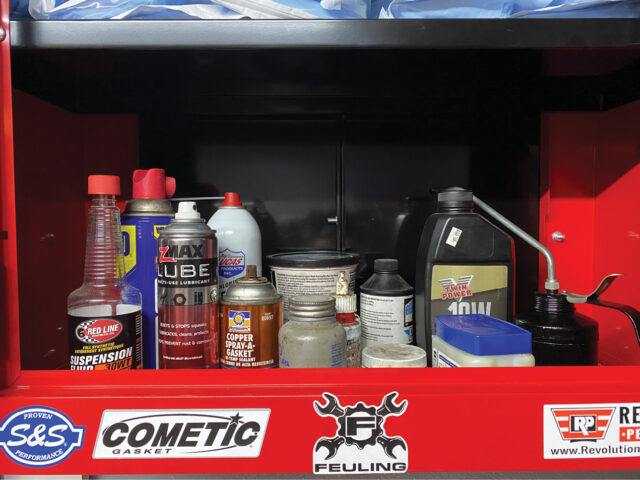
If you are using multi-layered steel head gaskets, I am going to recommend that you purchase a copper spray aerosol gasket dressing from Permatex. This spray can be used to dress almost any gasket surface and is especially effective when you spray the copper between the multi-layers of the gasket, but in the case of any metal gasket, I like to dust some of the copper spray on the gasket surface to ensure that the gasket can seal on any imperfect machined gasket surface.
Well, there you have it! There are several different types of sealants that we haven’t covered, but we can get to those later.