


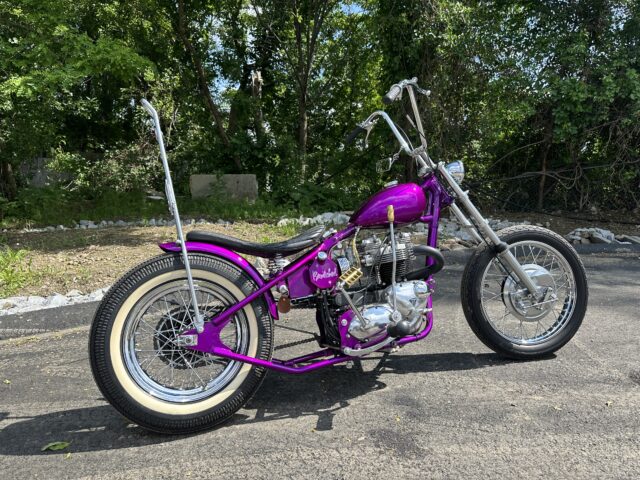
Some bikes are built to be looked at. Others are built to be lived with. James “Fish Tank” Berry’s 1970 Triumph Bonneville chopper falls squarely into the second camp. This is the kind of motorcycle that’s been apart more than once, carried through moves, family changes, and long stretches of life, then put back together when the idea finally clicks. Berry’s Triumph doesn’t chase trends or trophies, it tells a story about sticking with a machine until it becomes exactly what it’s supposed to be.

Berry is based in Merrimack, New Hampshire, and his Bonneville has been with him for a long time. This wasn’t a one-winter garage build. The bike first came together back around 2011, after he picked it up as a rough roller and frame from a friend’s basement. It wasn’t some untouched collector piece, and that mattered. It was just complete enough to be worth saving, and just rough enough to not feel guilty cutting into.

The first build took years. Five or six, by Berry’s count. Kids came along. He moved more than once. The bike followed, boxed up, unpacked, worked on when time allowed. Anyone who’s ever dragged a long-term project through real life knows that rhythm well. You don’t quit, you just pause, then pick it back up when you can.

Years later, Berry decided the bike deserved another round. He stripped it back down to the frame and started again, this time with a clearer idea of what he wanted out of it. Same Triumph soul, different attitude. Comfort mattered more. Character mattered more. And color, color really mattered.
Berry admits he’d been on a purple kick. He wanted a purple chopper, plain and simple, and the Bonneville was sitting there waiting to be reimagined instead of frozen in its old form. The result is a hardtailed ’70 Triumph T120 that still feels like a Triumph, but unmistakably belongs to the guy who built it.

Vintage Triumphs can be a touchy subject. In a lot of places, the few you see are restored to the letter and treated like museum pieces. Berry didn’t see many around his area at all, and the ones he did see weren’t bikes you’d want to chop. That made this one fair game from the start. It was never about preserving a showroom-perfect example. It was about building something rideable and personal.

One of the biggest choices on the bike is the handlebars. Berry went with 12-inch Emgo ape hangers, standard 7/8-inch Triumph-style bars. They’re wider than what he usually prefers, he’s more of a skinny bar, lane-splitter kind of guy, but he chose comfort. Rabbit ears might photograph cool, but these let him ride the bike without paying for it later. Arms up, knuckles in the breeze, and a natural posture that makes sense for real miles.
That comfort-first mindset shows up in the details too. Take the mirror. Berry found a lowrider bicycle mirror that clamps perfectly to 7/8-inch bars. Simple, cheap, and it worked. Even better, it came with purple reflectors that tied right into the paint. The mirror has a subtle twist to it, nothing flashy, just enough to keep the bike from feeling generic. Those small choices are often what separate a personal build from a catalog bike.

Brakes were another deliberate call. Berry loves modern hydraulic discs, but they didn’t belong here. To keep the old Triumph feel intact, he stuck with drum brakes front and rear. The front, though, is far from basic. He’s running a vented dual-cam drum race setup he found years back at an old shop near Nashua. At the time, he bought it because it fit his axle and front end. Later, he learned why it mattered.
That vented dual-cam front drum cools better and stops harder than a standard setup, which is important when, as Berry freely admits, the rear brake “doesn’t do so great.” Most of the real stopping happens up front, and having a solid front brake wasn’t optional if he wanted to ride with confidence.

The rest of the bike sticks to that same honest approach. The engine is a stock ’70 T120, 650cc, single Amal, stock ignition, pistons, heads, and cam. Power comes the old-fashioned way, backed by a stock primary and a hand-shifted Triumph transmission. Exhaust exits through a custom header capped with a Paughco fishtail, because some things just don’t need reinventing.
The frame is a stock ’70 Bonneville hardtailed with a four-inch stretch, running 2-over 33mm forks and stock trees. Wheels are stock Triumph units, a 19-inch front with a Duro tire and a 16-inch rear wrapped in a Shinko. The tank is a Lowbrow Customs P-Nut, the rear fender a Lowbrow Stingray, and the seat comes from River Seat Co. Lighting is straightforward Emgo and Prism Supply Co. stuff, functional, clean, and right for the bike.

The paint ties it all together. Illusion Violet powder coat laid down by BK Industrial Finishing gives the bike its presence without screaming for attention. That color is what led to the name Bewitched. Berry isn’t big on theme bikes, but he does like naming his machines. This one came together naturally, purple paint, October timing, and memories of watching old black-and-white TV shows like Bewitched with his grandmother. Add in the New England backdrop, not far from Salem, and the name fit without feeling forced.

That’s what makes this Triumph work. It’s not a gimmick. It’s not trying to be something it isn’t. It’s a second-chance build done with patience, lived-in knowledge, and respect for the bike’s roots. Berry’s Bewitched Bonneville proves that sometimes the best thing you can do for an old project is tear it down, rethink it, and build it again, this time exactly the way you want to ride it.
Bewitched Tech Sheet
Owner: James “Fish Tank” Berry
City/State: Merrimack, NH
Builder: Owner
Year: 1970
Model: Bonneville
Value: Priceless
Time: 9 Months
ENGINE
Year: 1970
Model: T120
Builder: Owner
Ignition: Stock
Displacement: 650
Pistons: Stock
Heads: Stock
Carb: Single Amal
Cam: Stock
Air Cleaner: Stock
Exhaust: Owner
Primary: Stock
TRANSMISSION
Year: 1970
Make: Triumph
Shifting: Handshift
FRAME
Year: 1970
Model: Bonneville
Rake: Stock
Stretch: 4” Up
FORKS
Builder: Owner
Type: 2+ 33mm
Triple Trees: Stock
Extension:
WHEELS
Front Wheel: Stock
Size: 19”
Tire: Duro
Front Brake: Vented Drum
Rear Wheel: Stock
Size: 16”
Tire: Shinko
Rear Brake: Stock Drum
PAINT
Painter: BK Industrial Finishing
Color: Illusion Violet
Graphics:
Chroming:
ACCESSORIES
Bars: Emgo 12” Apes
Risers: Custom CNC
Hand Controls: Emgo
Foot Controls: Stock
Gas Tank(s): Lowbrow P-nut
Oil Tank: Swap Meet
Front Fender: None
Rear Fender: Lowbrow Stingray
Seat: River Seat Co.
Headlight: Emgo
Taillight: Prism Supply
Speedo: None
Photographer: Heather Callen