


Thirty hours on bolt heads. That’s the kind of detail most people will never notice on a finished motorcycle, but for Brandon Hoffman, it’s exactly where the work matters. His 1986 Harley-Davidson FXR chopper looks clean from a few feet away. Pull the seat, take a closer look at the controls or get into the motor, and the same thinking carries through.
Hoffman, the builder behind Logic Cycles in Tionesta, Pennsylvania, walks us through the motorcycle in this Cycle Source Outta Focus feature. There’s an 89-cubic-inch stroker, a monoshock rear end, a wide open primary and plenty of fabrication. But the story isn’t just about the parts he chose. It’s about how far he went to make them work together.
A 1986 FXR With Dave Perewitz History
The starting point was a factory 1986 FXR with an unusual connection: according to Hoffman, the motorcycle had belonged to custom-building legend Dave Perewitz. Hoffman believes Perewitz intended to do something with it, but he doesn’t think that project ever came together. Chris had the bike before Hoffman bought it from him.
At the time of the walkaround, Hoffman said Perewitz’s name was still on the title, and he had paperwork to straighten out. That isn’t a claim about the bike’s current registration; it’s how Hoffman described its history during the feature.

The attraction was simple enough. Hoffman likes the lines and attitude of FXR choppers, so he set out to build one the way he pictured it, rather than chase somebody else’s idea of what an FXR ought to be.
An 89-Inch Stroker Without Cutting the Frame
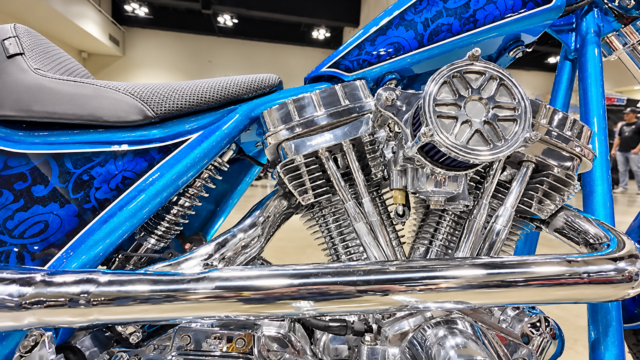
Underneath the sheet metal is an 89-cubic-inch engine assembled with Delkron cases, JIMS stroker flywheels and S&S pistons. Led Sled pan-style top covers give the motor another old-school visual touch. It’s a mix of pieces selected for the package Hoffman wanted, not a catalog engine dropped into a stock chassis.

Behind it sits a 1995 FLH transmission. Making that combination fit took some thought. Rather than modify the FXR frame, Hoffman reworked the oil pan to clear the drivetrain. Keeping the original frame intact was an intentional part of the approach.
He also fabricated the stainless-steel exhaust in-house. Its lines belong to this particular build instead of looking like an afterthought bolted on once everything else was finished.
A Monoshock Rear End That Makes You Look Twice
One of the most noticeable changes is at the back of the bike, where a Brock swingarm and monoshock setup give the FXR a different look from the typical twin-shock arrangement. The setup opens up the space around the rear wheel and gives the chopper a distinctive profile.
Hoffman likes motorcycles that make somebody stop, look again and try to figure out what’s going on. This rear suspension earns that second look. It stands out, but it also fits with the rest of the machine: nothing appears there just to fill space.
Sportster Mids, a Three-Inch Belt and Custom Fitment
Hoffman went with Speed Dealer pegs and controls and Arlen Ness handlebars, but the mid-control setup took more work than simply ordering a kit. He began with an older set of Sportster mids and adapted them to the FXR around the three-inch open belt.
That kind of change is easy to overlook in a quick walkaround. Getting the control placement and the open-primary clearance to coexist is the sort of practical fabrication that makes a one-off bike feel thought out rather than pieced together.
Thirty Hours on ARP Bolt Heads

Then there are the fasteners. Hoffman estimates he spent roughly 30 hours turning down ARP bolt heads to fit countersunk holes throughout the motorcycle. The point wasn’t to put shiny hardware in the obvious places and call it finished. He carried that decision into spots normally hidden from view.
Take off the seat and there is ARP hardware at the battery box. Hoffman also points out the hardware inside the engine and transmission. The individual bolt heads may be small, but choosing to make them consistent across the machine says plenty about his standards.
He sums up that attention to detail with a simple thought: the details are in every 12-point bolt. On this FXR, that’s more than a figure of speech.
Clean From the First Look to the Last Bolt

The monoshock may grab attention first, and the engine combination gives the bike its mechanical backbone. What ties Hoffman’s 1986 FXR together, though, is the determination to finish the work where most people would stop looking. From the modified oil pan to the adapted mids to the hardware tucked under the seat, every choice pushes toward the same goal.
Watch Hoffman’s full walkaround for a closer look at the bike and the pieces that make it his own.

This Cycle Source Outta Focus feature is brought to you by Garage Build and powered by Dennis Kirk.