


Bear’s Vintage Motorcycle Museum: A Lifetime of Motorcycles Inside an Ohio Mill
Some people collect bikes. Bear and his wife Sharon built an entire life around them. Tucked inside an 1881 feed mill in Ravenna, Ohio, Bear’s Vintage Motorcycle Museum isn’t just a room full of Harleys and Indians. It’s 45 years of busted knuckles, bad luck, big wins, and a marriage welded together by old iron. Now they’re hanging it up, the building and most of what’s inside are up for grabs, and Cycle Source TV got the kind of walk-through you don’t see twice.
Watch the full feature here before it all scatters to the wind:

From the minute you step into the front room, you can tell this isn’t some polished corporate collection. The mill still wears its history—old beams overhead, flour machinery tucked into corners, grain chutes towering over rows of motorcycles. Right up front, Evel Knievel greets you, not in statue form but in a wall of art, memorabilia, and a rare pinball machine that says as much about Bear’s eye for oddball treasures as it does about the legend himself. That Evel corner sets the tone: every piece in this place comes with a story, and Bear remembers them all.
As the camera moves deeper into the building, the bikes stack up fast. Harley Toppers with sidecars and weird factory windshields. A 1924 Royal Enfield built specifically for women riders, still wearing original paint and a skirt guard. A first-year Shovelhead set up with more clutch and shifter options than any sane person needs because its builder wanted to make sure he could still limp home after a long night of bar hopping. Speedway racers, war bikes, scooters that came out of catalogs, and a drag bike that went 189 mph in six seconds with a seventeen-foot wheelie bar hanging off the back. It’s a museum, but it feels more like crawling through time in some old-timer’s memory.
The episode doesn’t just rattle off makes and models. It keeps coming back to Bear and Sharon. You hear how he wasn’t supposed to have bikes at all because of a crash in his dad’s past, so of course the first thing he did at sixteen was buy a Panhead chopper and ride it to school. You hear about Sharon trading her wedding ring for a police trike at an AMCA meet because that’s how bad she wanted that bike. You hear how they went from a little Jammer-franchise shop on Main Street, to a total-loss fire with no insurance, to towing cars and paying every customer back before they’d even think about starting over.
That’s the real backbone of this museum: it’s not built on investors or grants. It’s built on second chances and stubbornness. Bear learning from the local Harley guru and buying tools one at a time. Hauling out basements full of old parts and turning them into rows of bin boxes. Moving the whole operation out to the farm when they had to, then coming back to town and filling that old mill until there were fifty thousand pieces of motorcycle history under one roof.
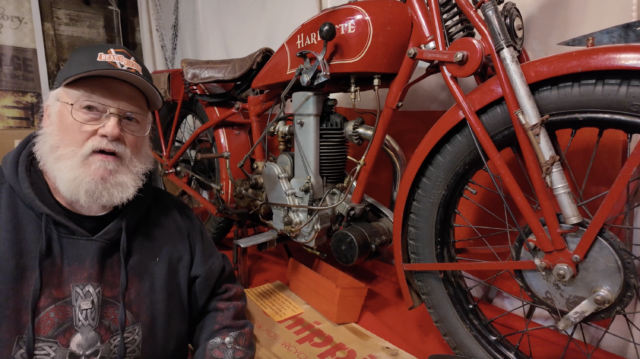
By the time the episode winds through the upper floors and corners, you’ve seen a lot: rare Harleys that challenge the books on build dates, a French-built “Harlay” with a tank shift and early hand clutch that never made it to American production, Indian war bikes with de-milled Thompsons strapped on, Zundapps that make American engineering from the same era look crude, a Panther motor wearing a Panhead top like some mad-science experiment. Add in movie bikes from CHiPs, Marlboro Man-era memorabilia, Dave Mann artwork, Shriners gear, AMF signs dealers never defaced, and a wall of Harley-branded everything, and your head starts to spin.
But the part that sticks with you isn’t the rarity. It’s the fact that Bear and Sharon are ready to let it go. Bear breaks it down with what he calls the eight sticks: one stick for each decade of your life. He’s standing on number seven now, and there’s only one left in front of him. That’s why he says it’s time to sell the kids’ inheritance, why he and Sharon would rather sit on the swing at the farm feeding bread to the fish than spend another decade dusting tanks and answering the same questions. They’ve done their part. They saved this stuff, shared it, and now it’s time for the next generation to decide what lives on.
That’s what makes this Cycle Source TV episode hit different. You’re not just looking at a cool collection; you’re seeing the end of a chapter for two people who gave everything they had to motorcycles and the community around them. The bikes will find new homes. The signs will hang in other garages. The stories, if we’re lucky, will keep getting told.
If you love real-deal bike history, old mill buildings, and the kind of mom-and-pop story you just don’t get from a corporate museum, do yourself a favor and watch this tour while you still can.
Hit play here, then stick around on Cycle Source TV for more garages, museums, and riders cut from the same cloth:
https://www.youtube.com/watch?v=mrKyBnWLhXE